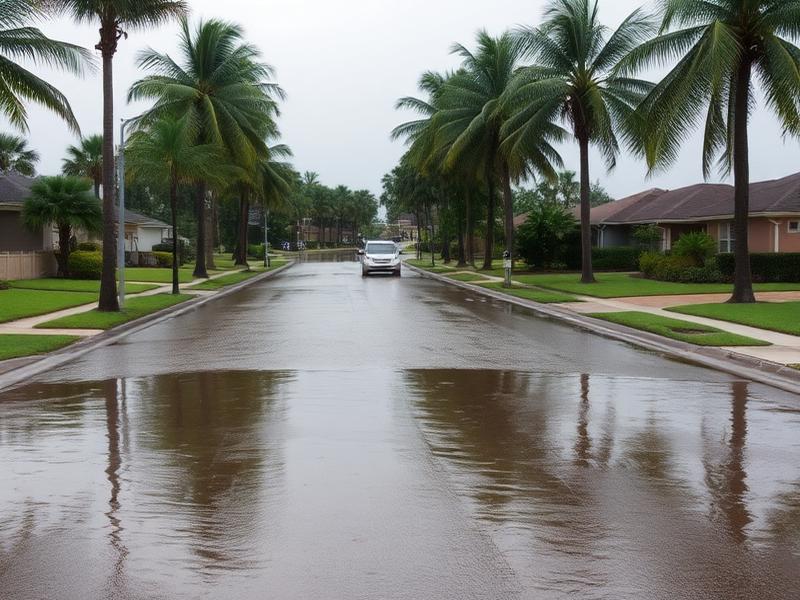
This page provides general information about flood zones and federal flood insurance requirements. It is not insurance advice, legal advice, or a substitute for consulting with a qualified insurance professional, lender, or attorney. Flood zone designations, insurance requirements, and premiums vary by property. You should always verify your property's specific flood zone using official sources and discuss your coverage needs with your insurance agent or lender.
What Is a Flood Zone?
A flood zone is a geographic area defined by the Federal Emergency Management Agency on Flood Insurance Rate Maps. These zones describe an area's level of flood risk based on historical data, rainfall patterns, topography, and proximity to water sources.
Flood zones are used to determine flood insurance requirements for federally backed mortgages, set building code standards for new construction and renovations, and inform community planning and emergency management.
FEMA updates these maps periodically. The most recent updates for Manatee County took effect on August 10, 2021. Sarasota County flood maps are also regularly updated, so you should always check the current map for any property you own or are considering.
Flood Zone Designations in Sarasota & Manatee Counties
FEMA uses letter designations to classify flood risk. The most common zones in Southwest Florida are:
Low to Moderate Risk
Zone X covers areas outside the 100-year floodplain. X unshaded is outside the 500-year floodplain, while shaded X or X500 indicates moderate risk between the 100-year and 500-year floodplain.
Insurance requirement: Flood insurance is not required by federal law for federally backed mortgages, though some lenders may still require it.
Where to find it: Common in many inland Sarasota and Manatee County neighborhoods, including parts of Bee Ridge, Fruitville, and areas east of I-75.
High Risk
Zone AE is a Special Flood Hazard Area with a 1% annual chance of flooding. A Base Flood Elevation is established for properties in this zone.
Insurance requirement: Flood insurance is required for properties with federally backed mortgages.
Where to find it: Common near Sarasota Bay, Little Sarasota Bay, coastal low-lying areas, canal-front communities, and the bay sides of barrier islands.
Coastal High Hazard Area
Zone VE applies to coastal areas subject to flooding and wave action of 3 feet or higher. It is one of the highest-risk flood designations.
Insurance requirement: Flood insurance is required for federally backed mortgages, and construction standards are stricter.
Where to find it: Primarily Gulf-front properties on Siesta Key, Lido Key, Longboat Key, Anna Maria Island, Casey Key, and other barrier-island waterfronts.
High Risk, No Established BFE
Zone A is a Special Flood Hazard Area where no Base Flood Elevation has been determined. It carries the same 1% annual flood risk as Zone AE.
Insurance requirement: Flood insurance is required for federally backed mortgages.
Where to find it: Found in high-risk areas where detailed elevation analysis has not been completed.
Undetermined Risk
Zone D indicates possible but undetermined flood risk. These areas have not been studied in detail.
Insurance requirement: Flood insurance is not required by federal law, but risk may still exist.
Where to find it: Less common, but important to investigate carefully when it appears on a property report.
Special Flood Hazard Areas
A Special Flood Hazard Area is FEMA's designation for areas with a 1% or greater annual chance of flooding. Zones AE, VE, A, AO, and AH are all SFHAs.
- Mandatory flood insurance for federally backed mortgages
- Elevated building requirements under the Florida Building Code and local ordinances
- Base Flood Elevation standards for construction and renovation
Federal law requires flood insurance for all properties in SFHAs with federally backed mortgages.
Base Flood Elevation
Base Flood Elevation is the calculated height floodwater is expected to reach during a 100-year flood event. BFE is measured in feet above sea level and appears on FEMA flood maps for Zone AE and VE properties.
Properties built at or above BFE may qualify for lower flood insurance premiums. New construction and substantial renovations in SFHAs must meet or exceed BFE requirements, and elevation certificates document a property's BFE compliance.
Elevation Certificates
An Elevation Certificate is a FEMA form used to document a building's elevation relative to the Base Flood Elevation. It is completed by a licensed surveyor and mapper.
It shows the lowest floor elevation of a structure, whether the building complies with BFE requirements, and information used to calculate flood insurance premiums.
Florida law requires surveyors to submit elevation certificates to the Florida Division of Emergency Management within 30 days of completion. Property owners should request one because it provides documented proof of a property's flood risk profile.
How to Find a Property's Flood Zone
For Sarasota County
- FEMA Flood Map Service Center: enter an address for official flood zone information.
- Sarasota County Property Appraiser: property search includes flood zone data.
- Sarasota County flood map questions: (941) 861-5000.
For Manatee County
- Manatee County Flood Zone Information Tool: search by address for current flood zone designations.
- Building & Development Services: floodplain management questions.
- Manatee County Building & Development: (941) 748-4501.
When Is Flood Insurance Required?
Federal law requires flood insurance when three conditions are met: the property is located in a Special Flood Hazard Area, the property has a federally backed mortgage, and the property secures a loan for a primary residence or commercial building.
If all three conditions apply, flood insurance is mandatory. Your mortgage lender is responsible for verifying your flood zone and requiring proof of coverage.
Cash buyers, paid-off homeowners, and borrowers with certain portfolio loans may not have a federal requirement, though a lender may still require coverage. Flooding can still occur outside SFHAs, and FEMA reports that a meaningful share of flood claims come from moderate-to-low-risk areas.
The 30-day waiting period matters: Flood insurance policies usually do not take effect immediately. You cannot wait until a storm is in the Gulf to buy coverage and expect it to apply to that storm. Limited exceptions may apply, such as at a mortgage closing.
Where to Go for More Information
Flood zone information is public record. You can and should verify any property's flood zone yourself using the official tools listed above.
For specific advice about your insurance needs, property, or mortgage, consult with a licensed insurance agent and your lender.